English · Українська · Polski · עברית · Español
Auerhan, Auerhahn, Orhan, Or-Chen: one family name
The same surname has been written at least six ways: in German-language registers in Galicia, on American passenger lists, in a memorial book, in the United States and in Israel. This page explains where each spelling came from.
What the name means
Auerhahn is German for the male capercaillie, the great wood grouse of the mountain forests of central Europe.[1] It is a bird name, like Adler (eagle) or Fink (finch): one of many surnames that Jewish families in Galicia took or were given after the Austrian emperor Joseph II made hereditary surnames compulsory in 1787.[2] It is not the same name as Auerbach, which comes from a German place name and belongs to unrelated families. The two are often confused.
Why one family could carry two surnames
The Austrian state recognized only marriages registered with the civil authorities. Many Jewish couples in Galicia married only in a religious ceremony, and the state counted their children as born outside marriage: they were registered under the mother's surname. Galician records mark the result. Recte ("correctly") introduces the legal surname; f. (falsch, "false") introduces the surname a person actually used. Brothers and sisters in one household could be written under different surnames, depending on whether their parents' marriage had been registered when each was born.[2][3]
An example from another Galician town: the surname list of the 1910 Jewish census of Tarnopol, published by Gesher Galicia, has three neighbouring entries, AUERHAHN, AUERHAHN f. FELD and AUERHAN. That is the name in two spellings, and someone legally named Auerhahn who used the surname Feld.[4]
The spellings
| Spelling | Where it is found | How it arose |
|---|---|---|
| Auerhahn | German-language registers in Galicia | The original German spelling |
| Auerhan | Galicia and New York | A simplified spelling, used in Polish and American records |
| Auerhun, Auerhoun | The English translation of the 1969 Strzyżów memorial book | How the translators rendered the name from Hebrew and Yiddish |
| Auerheim | Some passenger lists | Clerks wrote down what they heard |
| Orhan | The United States | A shortened form of the twentieth century |
| Or-Chen (אור-חן, also אור חן and אורחן) | Israel | A Hebrew name adopted after 1948 |
| אויערהאן, אורהאן | Yiddish and Hebrew writing | The German name written in Hebrew letters |
Or-Chen: a name remade
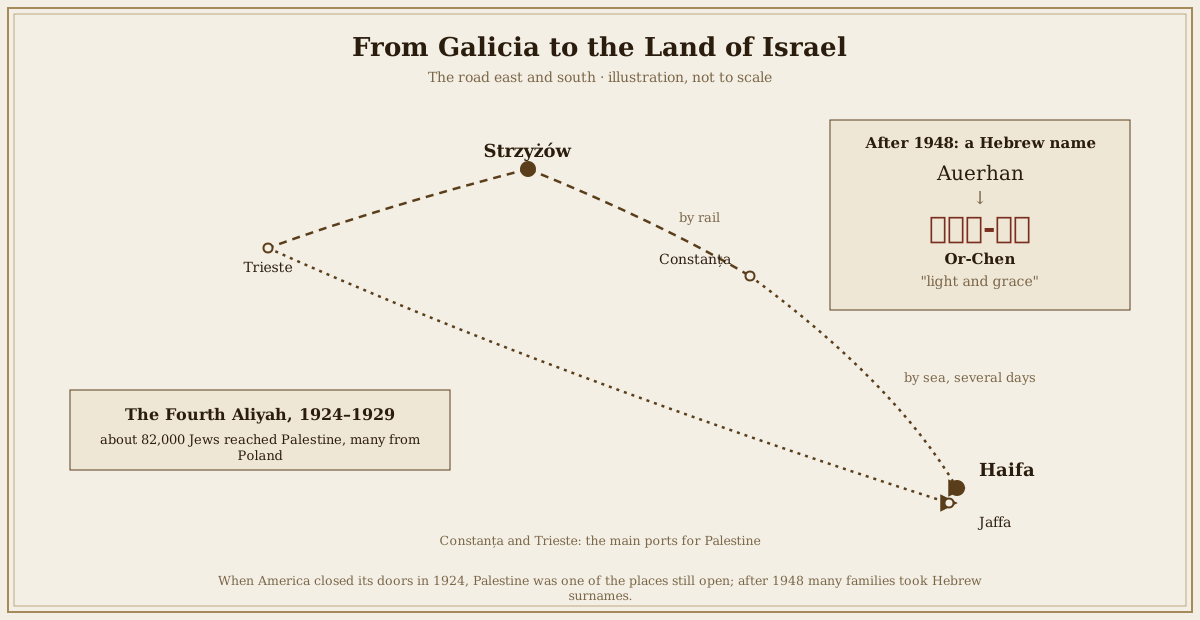
In the first decades of the State of Israel many thousands of families exchanged their European surnames for Hebrew ones, and in the mid-1950s David Ben-Gurion required diplomats and army officers to take Hebrew surnames.[5] אור-חן, Or-Chen, means "light and grace". It keeps the sound of Auerhan and gives it a meaning in Hebrew: the name did not survive by accident, it was remade.
One name on three continents
From 1 July 1924 the United States admitted only 5,982 immigrants a year from Poland.[6] Galician Jews who still wanted to leave went where the doors were open: to Argentina, to Brazil, and to Palestine, where the Fourth Aliyah of 1924–1929 brought about 82,000 Jews.[7] That is one reason the same Galician surnames are found today, in different spellings, in the United States, in Argentina and in Israel. For records of Jewish arrivals in Buenos Aires, see the Encyclopedia of Strzyżów.
Sources
- LEO German–English dictionary: capercaillie (Auerhahn, Auerhuhn)
- JewishGen KehilaLinks, Kolomea: Surnames and marriage in Galicia
- D. Hirschberg: Recte and false in Galician records
- Gesher Galicia: Tarnopol 1910 Jewish census surname list
- The Jewish Link: Insights into Jewish names and modern Israel
- Proclamation 1703 of 30 June 1924, establishing the nationality quotas for 1924–1925 (American Presidency Project)
- Jewish Virtual Library: The Fourth Aliyah (1924–1929)